
AI Tools for Learning: Effective and Time-Saving
AI Tools for Learning help you actively learn and identify mistakes. Discover the best applications for your educational journey! ➨ Learn more now!
Inhaltsverzeichnis:
AI tools for learning
AI tools for learning save time by guiding your thought process instead of just spitting out answers. I use them as patient learning partners, not as digital cheat sheets with Wi-Fi.
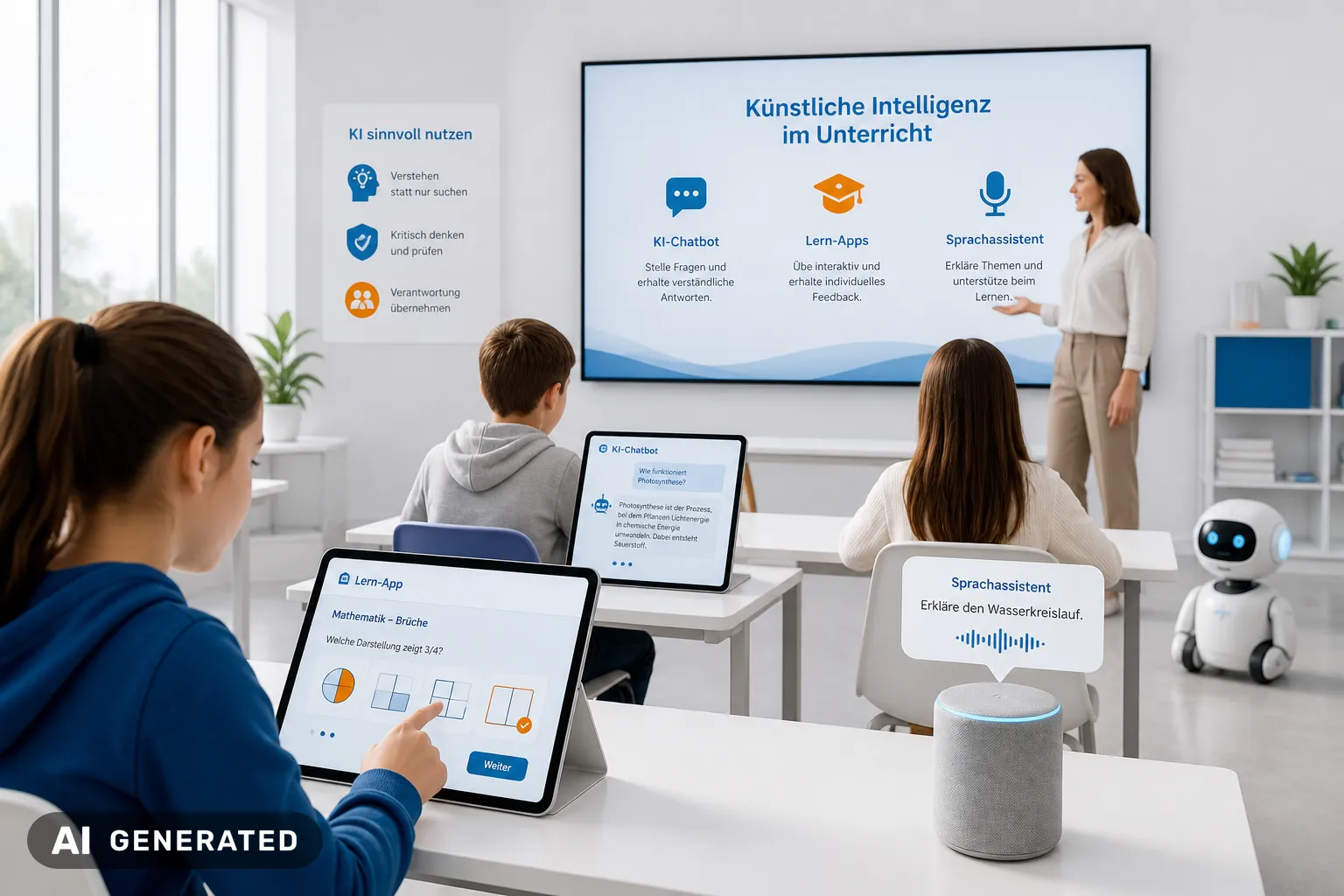
Artificial Intelligence has become a staple in learning by 2026. According to CHE DatenCHECK, 81 percent of students use AI at least weekly, and 46.5 percent use it daily.
- Chatbots explain complex terms, evaluate arguments, and create practice questions.
- Learning apps turn notes into flashcards, quizzes, or short review plans.
- Voice assistants correct texts and simulate conversations without awkward pauses.
AI speeds things up. True understanding happens when you verify answers and explain them yourself.
Which AI tools are the best? It's not about the longest feature list. For exam prep, you need different tools than for vocabulary or programming. In my opinion, the best AI tools for learning are those that actively quiz you.
If you're wondering which AI tools are free, there are many ways to start without a subscription. Kurslotse.de helps you categorize learning apps and online courses based on your goals. This way, 'learning with AI' becomes a plan that doesn't vanish after three days.
The best AI tools for learning
AI tools for learning are useful when they fill a specific learning gap: explaining, quizzing, or making mistakes visible. No tool can do everything at once, even if the homepage often promises it.
Which AI tools are the best?
The best AI tools depend on the task, not the loudest feature promise. Chatbots are particularly suited for comprehension questions and practice dialogues.
- ChatGPT explains terms, generates follow-up questions, and breaks down complex topics into small learning steps.
- Quizlet turns study material into flashcards and quizzes for active review.
- Wolfram Alpha clearly demonstrates problem-solving steps in math and science.
- Speechify reads longer texts aloud, saving time on scripts or academic articles.
When learning Python with AI tools I use chatbots as error finders. You input your code, request an explanation for each line, and test the suggestion yourself. Just copying the solution teaches you as much as watching a cooking video without a pan.
Use AI first for quizzing and explaining. Only then should it show you a model solution.
If you want to learn English with AI you mainly need conversation practice and direct corrections. For language learning with AI specialized language apps are often more suitable than a general chatbot. Chatbots sometimes invent facts or explain rules incorrectly. Always verify subject information with your course material or a reliable source.
How AI tools help with language learning
Learning languages with AI is effective when you correct mistakes immediately in an exercise. Vocabulary lists alone aren't enough. An AI chatbot simulates dialogues, corrects formulations, and adjusts the level to your responses.
When learning English with AI, you don't need to schedule appointments or pause conversations. From my experience, you quickly lose the fear of making mistakes. A chatbot doesn't get impatient, even if you use 'though' incorrectly for the eighth time.
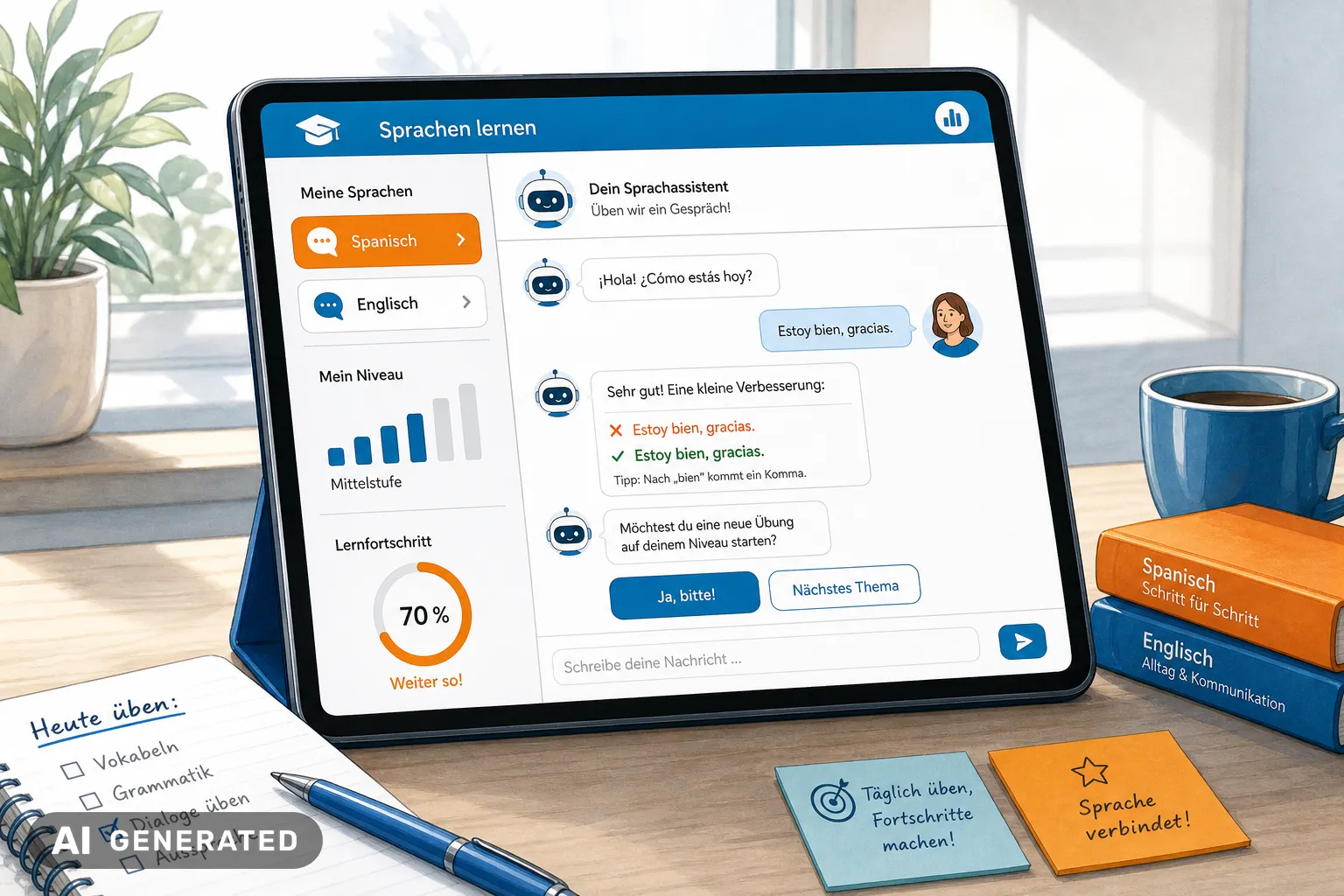
Here's how to integrate AI in language learning into your daily routine:
- Specify language, level, and situation, e.g., 'Spanish, A2, ordering at a café'.
- Respond to each question yourself instead of immediately getting a sample text.
- Request three corrected sentences with a short rule and a new follow-up question.
When learning Spanish with AI, you can use a restaurant dialogue. After each response, request only the two most important mistakes. This avoids overwhelming grammar rules.
An AI chatbot supports speaking only if you formulate your own sentences and repeat the corrections aloud.
Free language learning with AI works well for dialogues and vocabulary. For pronunciation, you need an app with voice recording. An AI avatar can motivate but doesn't replace a real conversation with different voices and reactions.
Tips for effectively using AI tools in everyday learning
AI tools for learning are valuable when you integrate them into your weekly schedule. Unplanned chats rarely lead to real knowledge, but rather to a full browser history.
How do you use AI tools for learning efficiently?
Plan 25 minutes for explanations, ten minutes for your own notes, and five minutes for a self-test for each new topic. This way, artificial intelligence remains your learning partner and not your substitute brain.
- Formulate each prompt with the subject, level of knowledge, and desired outcome format.
- Then ask for three follow-up questions that you answer without help.
- Note incorrect answers in an error log and review them two days later.
When learning Python with AI tools I first have an error message explained. Then I modify the code myself and request a second test case. This sequence separates understanding from blind copying.
Use AI first as a checker of your solution, not as the author of your solution.
You recognize the best AI tools for learning not by the number of features. What's crucial is whether you can solve the task the next day without a chatbot. In my opinion, a short error log is more beneficial than any extensive prompt collection.
Comparison of free and paid AI learning apps
Free AI learning apps are a good starting point. Paid options are worthwhile with regular training. I advise against subscribing before you've tested three real learning sessions.
If you want to know which AI tools are free, you'll often find basic versions for chats, flashcards, or explanations. For learning English with AI without registration, they're particularly suitable for trying out. Many applications hit their limits with longer conversations, pronunciation feedback, or personal learning plans.
- Free: Verify explanations, create ten flashcards, and practice short dialogues.
- Paid: Pay only for features you use at least twice a week.
- Test question: Solve five tasks without the app after the session and check your accuracy.
A subscription doesn't pay for your motivation. It only pays for time advantages, repetitions, or feedback.
When learning English with a free AI app, speaking training that shows progress is often missing. If you want to learn to speak English with AI, first test a five-minute dialogue. Then request three specific corrections.
For language learning with AI, chatbots are often sufficient for grammar and vocabulary. Those who want to learn a language with AI daily benefit more from saved errors and repetition plans. In my opinion, that's the only convincing reason for a subscription.
Which AI tools are free? The AI Campus offers free courses on artificial intelligence and awards certificates. Kurslotse.de helps you categorize such offerings alongside other learning formats.
Applications of AI tools in studies
AI tools in academics can speed up research and exam prep if you verify every suggestion. For a paper, I use ChatGPT as a question generator, not a ghostwriter. The university grades your argumentation, not the charm of a chat window.
Clearly separate research, writing, and practice
In literature, data, and exam prep, AI applications serve three distinct roles:
- Literature research: Get search terms, synonyms, and counterarguments, but read the original source yourself.
- Writing: Ask for an outline and then highlight each thesis that needs evidence.
- Programming: When learning to program with AI, have it explain an error and test three of your own inputs.
No AI response belongs in a paper until you've checked the source, context, and terminology.
For a ten-minute presentation, I start with three questions on the topic. Then I formulate an answer without help and only check for logical errors. This order prevents a smooth summary from replacing your understanding. The University Library of Duisburg-Essen clearly separates AI-assisted research from academic work.
Before an English presentation, learning to speak English with AI helps if the chatbot asks critical follow-up questions. Learning English with AI doesn't replace reading specialist literature. For a semester abroad, you can practice learning Spanish with AI and learning Italian with AI through role-playing.
Limits and challenges of AI tools in learning
AI tools for learning can sometimes provide convincingly incorrect answers. This makes them more dangerous than obvious errors. A made-up book title or a wrong formula often sounds surprisingly correct in the chat window.
For papers, you should verify every piece of evidence in the original source. ChatGPT and other chatbots don't replace databases, specialist literature, or your university's rules.
- Check names, numbers, and quotes directly in the cited source.
- Don't input personal data, exam questions, or confidential documents into public applications.
- First, formulate your solution yourself and then use AI for counter-questions.
- Clarify before submissions which AI usage your university allows.
An AI answer is a draft, not proof.
In language learning with AI there's another catch: A chatbot corrects grammar but doesn't always accurately recognize tone and regional nuances. English politeness can quickly sound different than a direct German translation. Those who want to learn English with AI should also practice dialogues with real people.
I find it particularly problematic when AI fills every pause in thought. From my experience, understanding only arises when you break down a task yourself for five minutes. Only then do AI tools help make logical errors visible instead of taking over your thinking.
The impact of AI on different learning styles
AI tools for learning aren't limited to fixed learning styles but adapt to different learning tasks and preferences. Honestly, I think rigid learning style categories are nonsense.
Visual learners benefit from tables, processes, or image descriptions. Verbally oriented learners practice dialogues and receive sentence corrections. Those who learn by experimenting receive tasks in small steps.
Here's how you adapt AI to your learning style
- Visual: Ask ChatGPT for a sketch description and then explain it without help.
- Auditory: Have dialogues for learning English with AI written and read both roles aloud.
- Active: Request a task first, then a hint, and only lastly the solution.
In language learning with AI, your goal matters more than your supposed learning style. For learning English with AI for free, short role plays with three everyday situations are suitable. For learning Spanish with AI, you should vary the same five sentences multiple times.
A worldwide survey from 2026 included 45,398 responses from 35 countries. 88 percent of students used AI in learning. This number clearly shows practical use, even if it doesn't prove learning success.
AI is most helpful when you switch between explaining, applying, and recalling.
I find: Learning English with AI works better with your own voice than with silent reading. Whether you want to learn Italian or English with AI, test yourself after each session without a chat window.
FAQ on AI tools for learning
AI tools for learning only bring progress if you actively verify and formulate answers yourself. I see chatbots more as patient trainers than as homework machines.
What are AI tools?
AI tools are applications that generate texts, tasks, or feedback from your inputs. A chatbot explains terms, creates questions, and corrects example sentences. For learning with AI for free often a chat window, your own notes, and a clear task are enough.
Write something like: "Test me with five questions on chapter three and explain each wrong answer." This form forces you to recall.
The AI Campus offers free courses, videos, and certificates on artificial intelligence. Free chatbot access is suitable for short explanations and practice questions. Check with each application which features remain available without a subscription.
Can I learn English with AI for free?
Learning English with AI for free works well with short dialogues and loud pronunciation. For learning to speak English with AI, write out three everyday situations. Order in a café, ask for directions, and complain about a wrong hotel room.
- Speak each answer out loud instead of just reading it.
- Ask for a correction with no more than two errors per round.
- Repeat the same dialogue after ten minutes without help.
Does learning languages with AI for free also work for Spanish or Italian?
Yes, learning languages with AI for free is also suitable for Spanish and Italian dialogues. When learning Italian with AI, it's better to practice ten common sentences than a hundred new words. For learning Spanish with AI for free, request regional variations, otherwise, your dialogue might quickly sound like a language book from 1998.
A good prompt demands follow-up questions, error correction, and repetition. A finished model solution mainly trains your thumb.
Conclusion
AI tools for learning are useful when they enhance your thinking and don't do everything for you. The best results come from questioning, recalling, and correcting. Copy-pasting might seem clever in the short term, but during the exam, your mind will quickly go blank.
I find that chatbots particularly shine as patient learning partners. They explain the same material in different ways until it sticks. For AI tools for language learning short dialogues, loud repetition, and specific error corrections are more effective than endless vocabulary lists.
Use AI first for a task, then for a hint, and only finally for the solution.
A sensible learning block consists of three steps: You explain a topic without help, have understanding gaps checked, and then answer new questions. This approach is suitable for math, programming, exam prep, and any foreign language.
- ChatGPT for explanations and exercises
- Quizlet for review
- AI Campus for foundational knowledge about artificial intelligence
Which AI tools are free depends on the respective functionality. AI tools for learning free are usually sufficient for initial learning routines.
Honestly, it doesn't matter which AI tools are the best. What's crucial is whether you can explain something without a screen after each session. Kurslotse.de helps you find suitable learning offers and learning apps based on your real goal.
You might also be interested in
Sources
Ich bin Tim, 26 Jahre alt, und schreibe hier über Online-Kurse und Weiterbildung. Mein Ziel ist simpel: Du sollst den Kurs finden, der wirklich zu dir passt.
 Beitrag geschrieben von Tim Geier. Mehr über den Autor.